Three Paths for Plastic Waste
Three ways to handle plastic waste — mechanical recycling (melt and remould), pyrolysis (sealed pot, no oxygen, recovers fuel), and incineration (open flame, energy recovery, high emissions) — each with different products, conditions, and environmental implications.
Beyond definitions
Planning to start a Plastic Pyrolysis business?
Get the full business understanding — capex, regulations, machinery, vendor questions, and risk checks before you commit capital.
How to read this sketch
Three panels arranged side by side in order of energy recovery vs material recovery. Read each panel top-to-bottom:
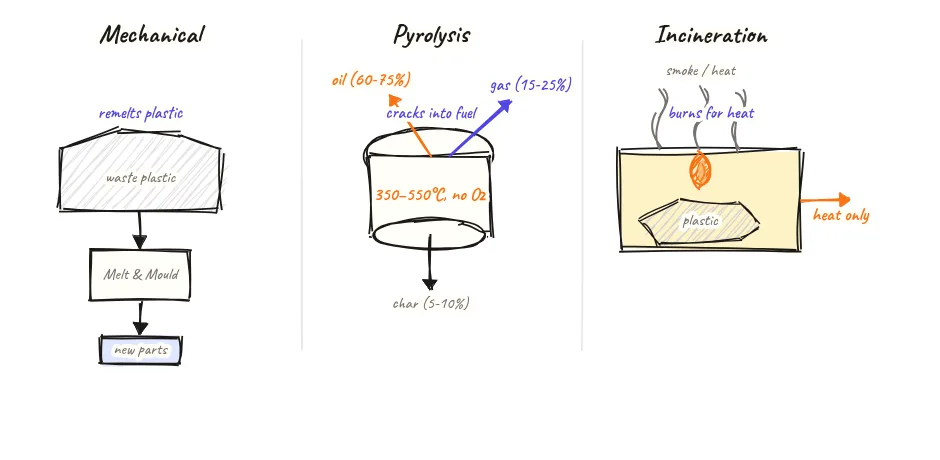
- Left — Mechanical recycling: Plastic enters the top, is processed (shown as arrows through a pelletiser and moulder), and exits the bottom as new plastic material. No heat and no chemical change in the polymer backbone.
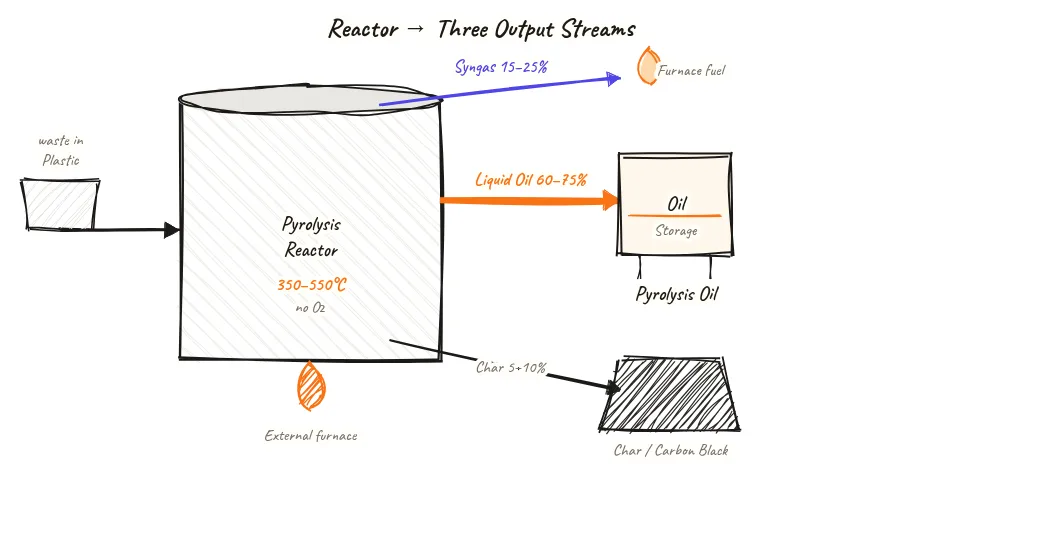
- Centre — Pyrolysis: Plastic enters a sealed closed pot. Heat applied from outside. Three outputs exit (vapors upward to oil, gas at side, char at bottom). 'no O₂' label is central to the process condition.
- Right — Incineration: Plastic enters the top. Open flame shown inside the chamber. Flue gas exits the top. Ash exits the bottom. Only energy recovery, no material product.
- Caption: 'Three routes — remelt, crack, or burn. Only pyrolysis recovers fuel without air.'
About this sketch
When faced with plastic waste that cannot be avoided, there are three main technical pathways for handling it. This comparison diagram shows all three side by side, making it immediately clear how they differ in process conditions, products, and environmental impact.
Mechanical recycling (left panel) is the most material-efficient route for clean, single-type plastic. The plastic is shredded, washed, melted, and extruded into new pellets or moulded directly into new products. It conserves the polymer structure — the output is a material (recycled plastic) rather than a fuel. Limitations: it only works for unmixed, relatively uncontaminated plastic. Category IV multi-layer, thermoset, and heavily contaminated plastics cannot be mechanically recycled — they end up in landfill or sent to the other two routes.
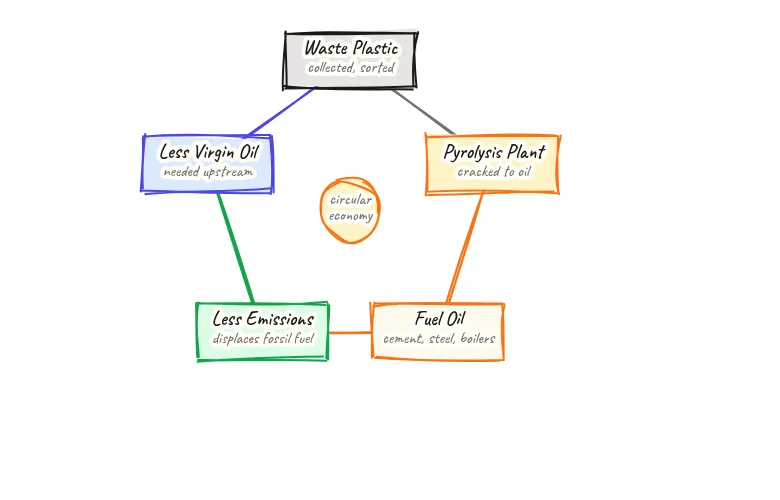
Pyrolysis (centre panel) heats plastic to 350–550°C in a sealed vessel with no oxygen. Without oxygen, combustion cannot occur — instead, long polymer chains thermally crack into shorter hydrocarbon chains. The products are pyrolysis oil (liquid fuel), syngas (gaseous fuel), and carbon char (solid). Pyrolysis handles the Category IV plastics that mechanical recyclers reject. It is the middle route — not as material-efficient as mechanical recycling, but recovers useful fuel value rather than wasting it as landfill.
Incineration (right panel) burns plastic with excess air in a combustion chamber. All the carbon and hydrogen in the plastic converts to CO₂ and H₂O — pure energy recovery with no material product. Heat generated can produce steam and electricity. Limitations: requires an expensive pollution control system (significantly more complex than pyrolysis APCS due to dioxin and furan formation), has high capital cost, produces large volumes of fly ash requiring disposal, and is the least material-efficient of the three routes. Most Indian pyrolysis operators correctly position their technology as preferable to incineration for plastics that cannot be mechanically recycled.
Key insights
- Pyrolysis is the only route that recovers fuel from plastic without using oxygen — the 'no O₂' condition is what separates it from incineration and what allows fuel product recovery.
- Mechanical recycling is the highest-value route for clean, uncontaminated single-type plastic — but most post-consumer mixed plastic cannot be mechanically recycled.
- Incineration destroys all material value in the plastic — 100% of carbon becomes CO₂. Pyrolysis recovers 60–70% as usable fuel before the remainder becomes emissions.
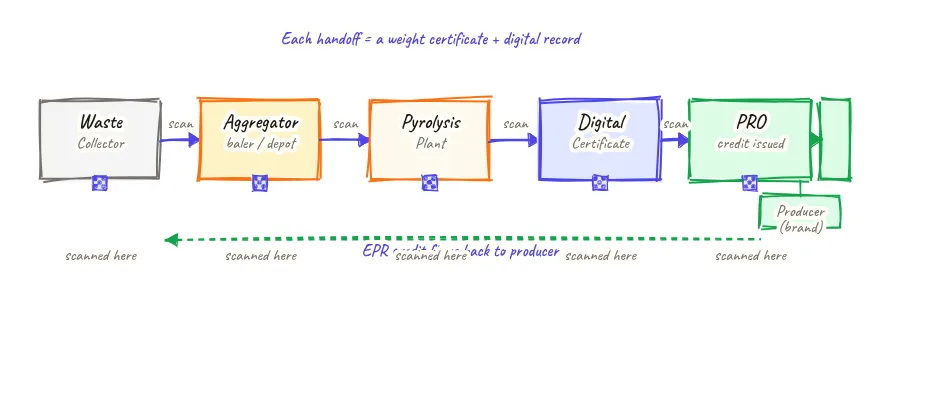
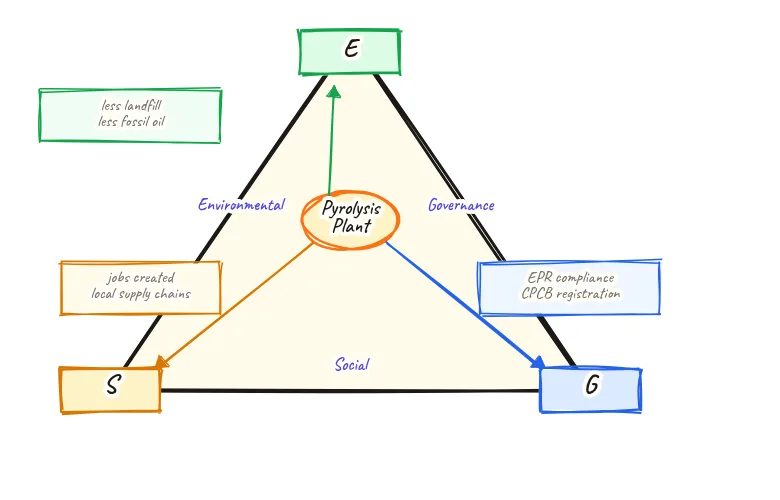
- Extended Producer Responsibility (EPR) rules in India now mandate targets for plastic recycling including chemical recycling (pyrolysis) as an accepted route for Category IV plastic.
- The three routes are not competing for the same plastic — they handle different grades and qualities, with mechanical recycling for clean plastic and pyrolysis for Category IV mixed waste.