Crude Oil to Fractions — Distillation Upgrading
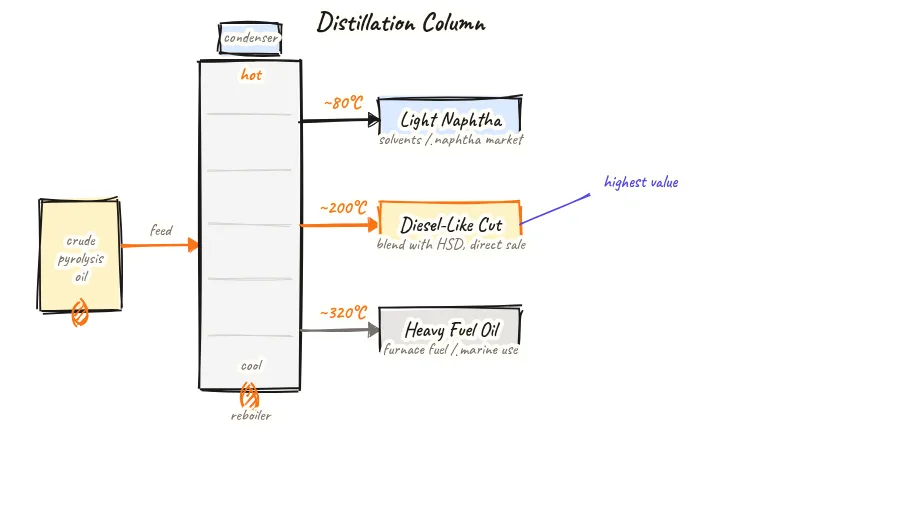
A distillation column separates crude pyrolysis oil into three commercial fractions — light naphtha at the top, a diesel-like middle cut in the middle, and heavy fuel oil at the bottom — each with distinct buyers and prices compared to selling undifferentiated crude oil.
Beyond definitions
Planning to start a Plastic Pyrolysis business?
Get the full business understanding — capex, regulations, machinery, vendor questions, and risk checks before you commit capital.
How to read this sketch
This is a vertical process diagram with the distillation column as the central element. Read it as follows:
- Feed line (left, mid-height): Crude pyrolysis oil enters the column at its mid-point — the feed stage.
- Reboiler (base): Heat source at the column bottom, vaporising the heaviest fractions to drive the separation.
- Column body: Vertical vessel with internal trays or packing. Higher position = lighter fractions. Lower position = heavier fractions.
- Top draw (light naphtha): Condenser at the very top. Light naphtha product comes off here.
- Side draw (middle distillate): An off-take line at a mid-column height. Diesel-like fraction.
- Bottom product (heavy oil): Residue at the column base — heaviest, darkest fraction.
- Caption: 'Plain oil sells for one price — fractions sell for three.'
About this sketch
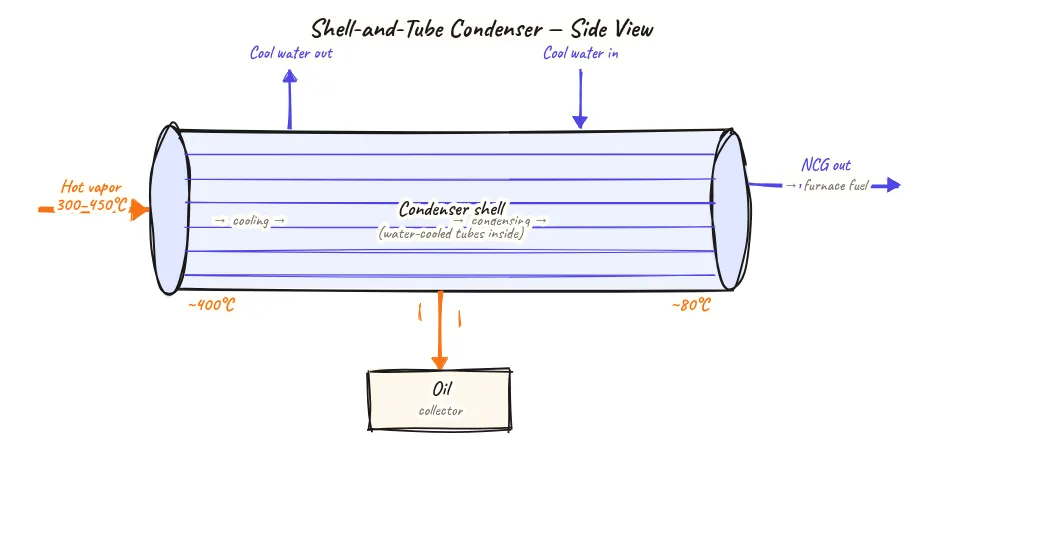
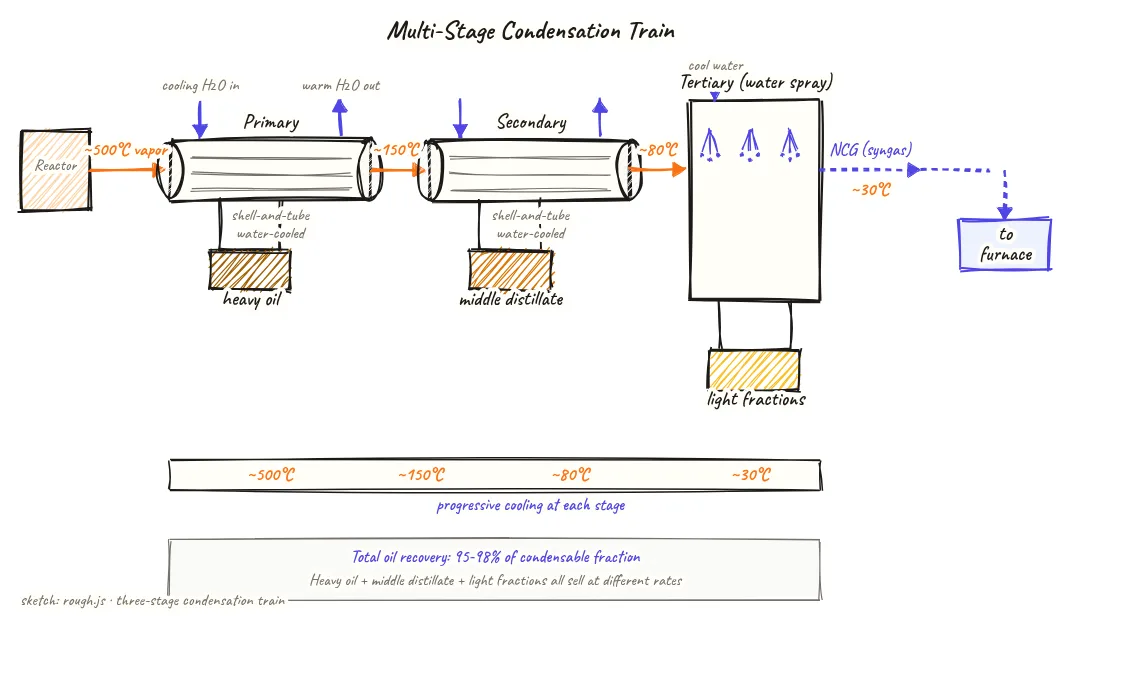
Crude pyrolysis oil — the mixed liquid collected from the condenser train — is a blend of hydrocarbon fractions ranging from light naphtha (C5–C9, boiling below 150°C) through middle distillates (C10–C15, boiling 150–350°C) to heavy oil (C16+, boiling above 350°C). Selling it blended gives one average price. Running it through a distillation column separates it into three distinct commercial grades, each with its own buyer market and price.
The distillation process exploits the fact that different hydrocarbons have different boiling points. Crude oil is fed into the column and heated at the base by a reboiler. Lighter fractions vaporise first and rise up the column. A condenser at the top condenses the lightest vapors back into liquid — some returns as reflux (to sharpen the separation), and some is withdrawn as the light naphtha product. Light naphtha (C5–C9) has properties similar to petroleum naphtha and can be used as a solvent or industrial cleaner.
The middle cut draw-off at a mid-column height captures the diesel-range fraction (C10–C15, boiling 180–300°C). This is the most valuable fraction from plastic pyrolysis — it has cetane number and viscosity properties approaching IS 1460 diesel standard, though hydrotreating is typically needed for full diesel grade. Middle-cut oil sells at a premium over crude pyrolysis oil to agricultural equipment dealers, generator operators, and industrial users.
The heavy residue at the column bottom (C16+, above 350°C boiling point) is a dark, viscous fuel oil suitable for cement kilns, industrial boilers, and brick kilns. It is the lowest-value fraction but still represents a defined product rather than a blended crude.
A distillation column adds capital cost (typically ₹15–35 lakh for a simple batch still suitable for 10–20 KL/day throughput) and operating energy cost. The additional revenue from selling three defined fractions versus one blended crude typically justifies this investment for plants processing above 10 TPD.
Key insights
- Distillation separates crude pyrolysis oil into three fractions by boiling point — light naphtha, middle distillate, and heavy residue — each with a different buyer and price.
- The middle distillate (diesel-range fraction) is the highest-value product and commands a premium of 20–40% over undifferentiated crude pyrolysis oil.
- A batch distillation still (the simpler option for 10–20 KL/day) costs significantly less than a continuous fractionating column but requires more operator attention.
- The heavy residue at the column bottom still has commercial value as fuel for kilns and boilers — it is not a waste product but a defined product stream.
- Distillation makes business sense for plants above 10 TPD where the added revenue covers the capital and energy cost within 2–3 years.