Allowed vs Restricted Feedstock Plastics
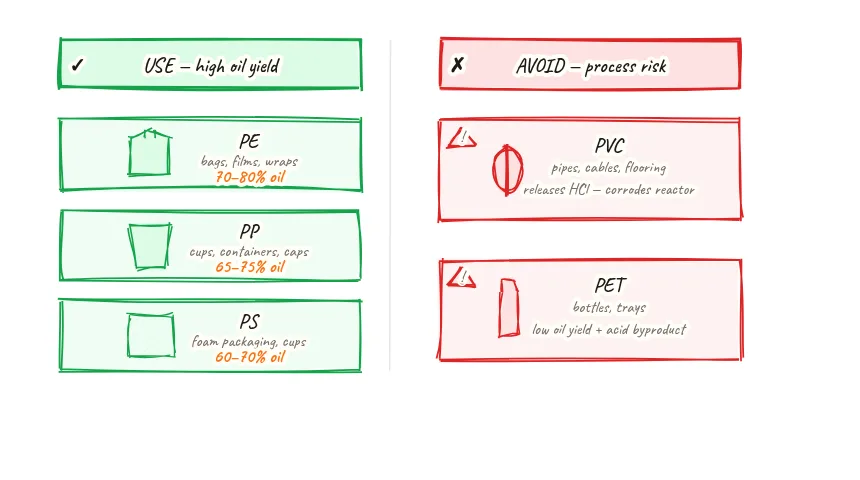
A quick-reference guide showing which plastics are suitable for pyrolysis feedstock (PE bags, PP cups, PS foam) with their expected oil yields, versus which plastics must be kept out (PVC pipes, PET bottles) and why they cause equipment damage and poor yields.
Beyond definitions
Planning to start a Plastic Pyrolysis business?
Get the full business understanding — capex, regulations, machinery, vendor questions, and risk checks before you commit capital.
How to read this sketch
Two columns arranged side by side. Left column is green (allowed); right column is red (restricted). Read each column top-to-bottom:
- Green column (allowed plastics): Each entry shows a plastic item icon + abbreviation (PE, PP, PS) + oil yield percentage. The yield label is the key commercial information.
- Red column (restricted plastics): Each entry shows a plastic item icon + abbreviation (PVC, PET) + warning annotation. HCl warning for PVC; low yield + acid warning for PET.
- Caption: 'Not all plastics behave the same in heat — sort before you feed.'
About this sketch
Every feedstock sorting decision at a pyrolysis plant comes down to one question: does this plastic belong in the reactor or in the reject bin? This two-column visual provides the answer at a glance for the five most common plastic types found in Indian waste streams.
The allowed column (green, left) shows three plastics that make good pyrolysis feedstock:
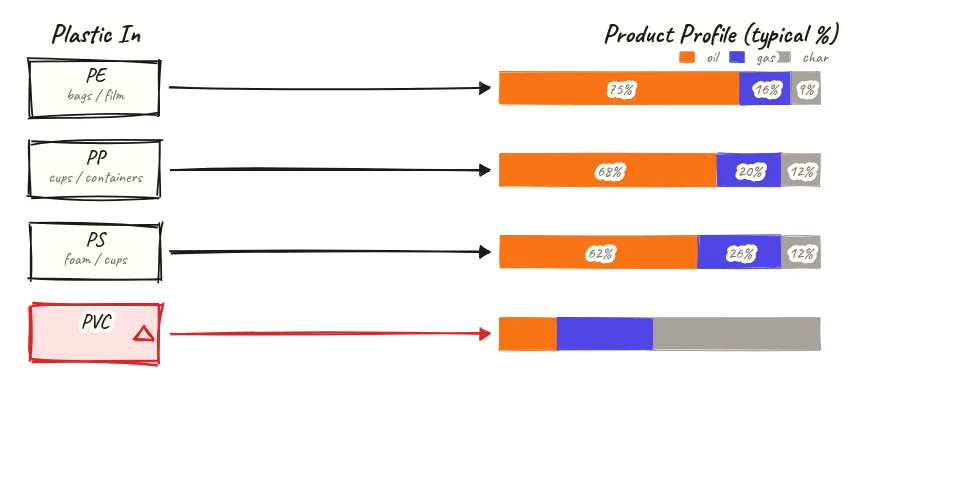
PE bags and film — the most abundant plastic waste in India. LDPE and HDPE both give 65–75% oil yield with oil properties close to light diesel. All varieties are acceptable (black film, clear film, coloured bags) except where they contain significant metal foil lamination.
PP cups and containers — the second most common plastic in municipal waste. PP gives 60–70% oil yield and can be mixed freely with PE. Includes yoghurt cups, sauce bottles, disposable plates, woven PP bags (but not if heavily soiled with cement or fertiliser, which adds ash).
PS foam — expanded polystyrene (EPS) cups, packaging trays, thermocol blocks. Gives 55–65% oil yield but the oil has a high aromatic content and pungent styrene odour. Acceptable in the mix but buyers should be informed of PS content above 20%.
The restricted column (red, right) shows two plastics that must be sorted out:
PVC pipes and products — 57% chlorine by weight. PVC generates HCl gas when heated, which corrodes reactor walls, condenser tubes, and vapor lines, contaminates the oil with chlorinated compounds (making it acidic and unsellable), and produces toxic HCl emissions requiring special scrubber treatment. Even small quantities (1–2%) of PVC in the feedstock cause measurable corrosion and contamination problems.
PET bottles — used for water, soft drinks, and edible oil packaging. PET (polyethylene terephthalate) contains oxygen in its polymer backbone. When pyrolysed, it generates primarily CO₂ and water rather than hydrocarbons, giving very low oil yield (10–20%). The oxygen content also makes it a dilutant in the reactor, consuming energy without producing valuable product.
Key insights
- PE bags and film are the best pyrolysis feedstock available in Indian waste streams — highest oil yield (65–75%) and oil closest to diesel properties.
- PVC must be sorted out even at 1–2% contamination — the HCl it generates is corrosive to all metal surfaces in the plant and contaminates the oil.
- PET (water bottles) should also be avoided — oxygen in PET's backbone gives very low oil yield (10–20%) and consumes reactor energy unproductively.
- PS foam can be included in the feedstock mix but buyers may need to be informed due to the aromatic character of PS-derived oil.
- A simple float-sink test (PVC sinks in water, PE and PP float) can separate most of the PVC from a mixed plastic stream without expensive equipment.