What's Inside a Circuit Board
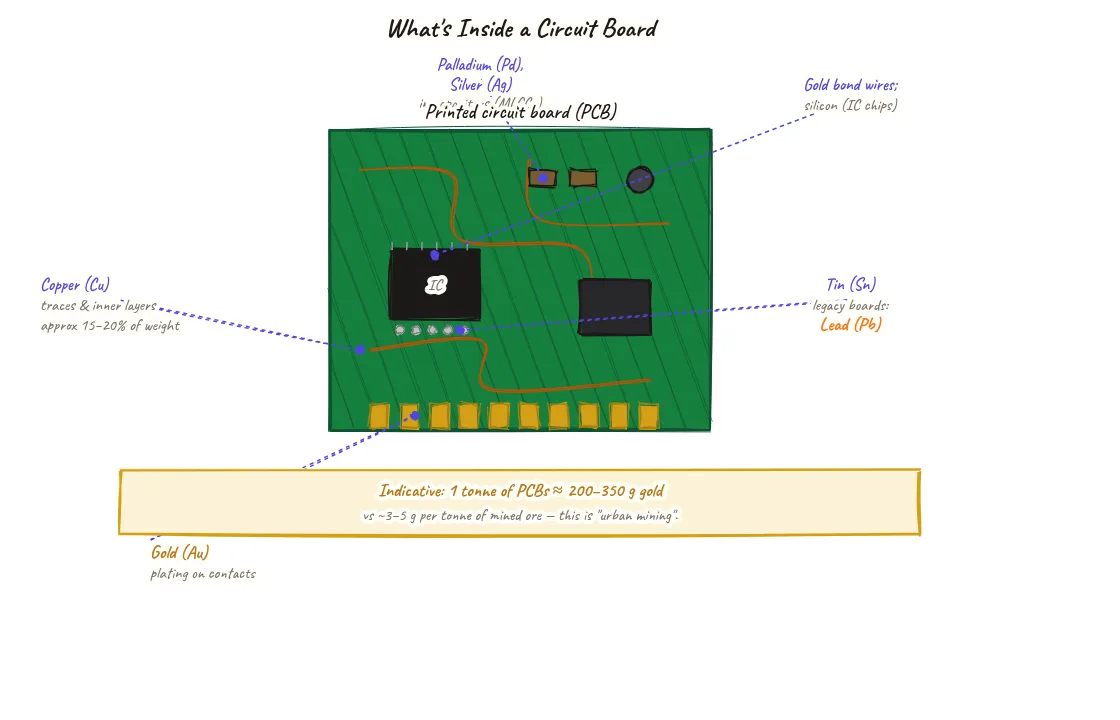
Maps where each recoverable metal sits on a circuit board, gold on the edge connectors, copper in the traces, palladium and silver in capacitors, with a gold grade far richer than natural ore.
Beyond definitions
Planning to start a E-waste business?
Get the full business understanding — capex, regulations, machinery, vendor questions, and risk checks before you commit capital.
How to read this sketch
- Callout labels: each line points from a metal name to the part of the board where that metal is physically found.
- Edge connectors: gold plating, top-value harvest target.
- Traces and inner layers: copper, the largest metal fraction by weight.
- Capacitors and chip area: palladium, silver and fine gold bond wires.
- Bottom banner: the headline grade, 1 tonne of PCBs yields roughly 200 to 350 g of gold.
About this sketch
This diagram opens up a printed circuit board and labels exactly where each recoverable metal lives, which is the foundation of why e-waste refining is worth doing at all. The board is far from a uniform block of scrap; value is concentrated in specific components, and knowing the map tells a dismantler what to harvest first.
Gold appears as a thin plating on the edge connectors and contact fingers, chosen because it does not corrode and conducts reliably. Copper is the workhorse, making up roughly 15 to 20 percent of the board weight in the traces and inner layers. Palladium and silver hide inside the multilayer ceramic capacitors, and additional fine gold sits in the bond wires near the silicon chips. Tin holds the joints together as solder, and on older legacy boards that solder also contains lead, which is why vintage boards are handled as a hazardous stream.
The number that drives the whole sector sits at the bottom: one tonne of printed circuit boards yields roughly 200 to 350 grams of gold. To put that in perspective, a good natural gold ore might carry only a few grams per tonne, so board scrap is effectively a far richer ore than anything mined. This concentration is precisely why integrated refiners invest in smelting or leaching plants rather than simply selling boards on.
For an Indian recycler the practical lesson is that grading and segregating boards by type, telecom, server, consumer, matters enormously, because high-grade boards from servers and networking gear carry far more precious metal per kilo than low-grade consumer boards, and they command correspondingly different prices from refiners.
Key insights
- Gold sits as a thin plating on the edge connectors and contact fingers because it resists corrosion and conducts reliably.
- Copper is the largest metal fraction at roughly 15 to 20 percent of the board weight, held in traces and inner layers.
- Palladium and silver are concentrated inside multilayer ceramic capacitors, with extra fine gold in the chip bond wires.
- One tonne of printed circuit boards yields roughly 200 to 350 grams of gold, far richer than typical natural ore.
- Server and telecom boards carry much more precious metal per kilo than consumer boards, so grading by type drives the price.