Magnetic + Eddy-Current Metal Separation
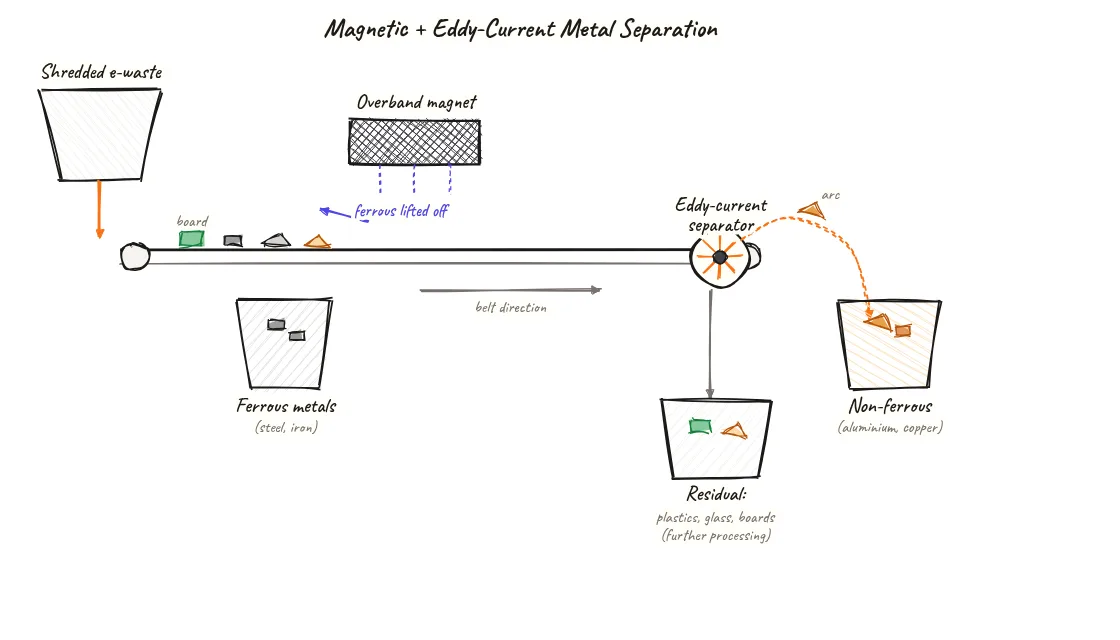
Shows how a magnet pulls out steel and iron from shredded e-waste, then an eddy-current separator throws out aluminium and copper, leaving the plastics and boards behind.
Beyond definitions
Planning to start a E-waste business?
Get the full business understanding — capex, regulations, machinery, vendor questions, and risk checks before you commit capital.
How to read this sketch
- Conveyor belt (left to right): follow the shredded feed as it travels through each machine in sequence.
- Overband magnet (top): lifts ferrous metals upward and away from the belt.
- Eddy-current rotor: throws conductive non-ferrous pieces forward into a separate bin; arrows show the ejection direction.
- Drop-down stream: material that is neither magnetic nor conductive falls straight through as the residual plastics, glass and boards fraction.
About this sketch
This diagram follows shredded e-waste as it moves along a conveyor and is split into three streams by two purely physical machines. First the feed passes under an overband magnet, a magnet suspended above the belt that lifts out ferrous metals such as steel and iron from screws, casings and chassis. Because these metals stick to a magnet and nothing else on the belt does, this is the cleanest and cheapest separation step in the whole line.
What stays on the belt then reaches an eddy-current separator. A fast-spinning magnetic rotor induces a swirling current inside any non-magnetic but conductive piece, which briefly turns each fragment into a tiny magnet that is repelled and physically thrown forward off the end of the belt. This is how aluminium and copper are flicked into their own collection bin while non-conductive material simply drops straight down.
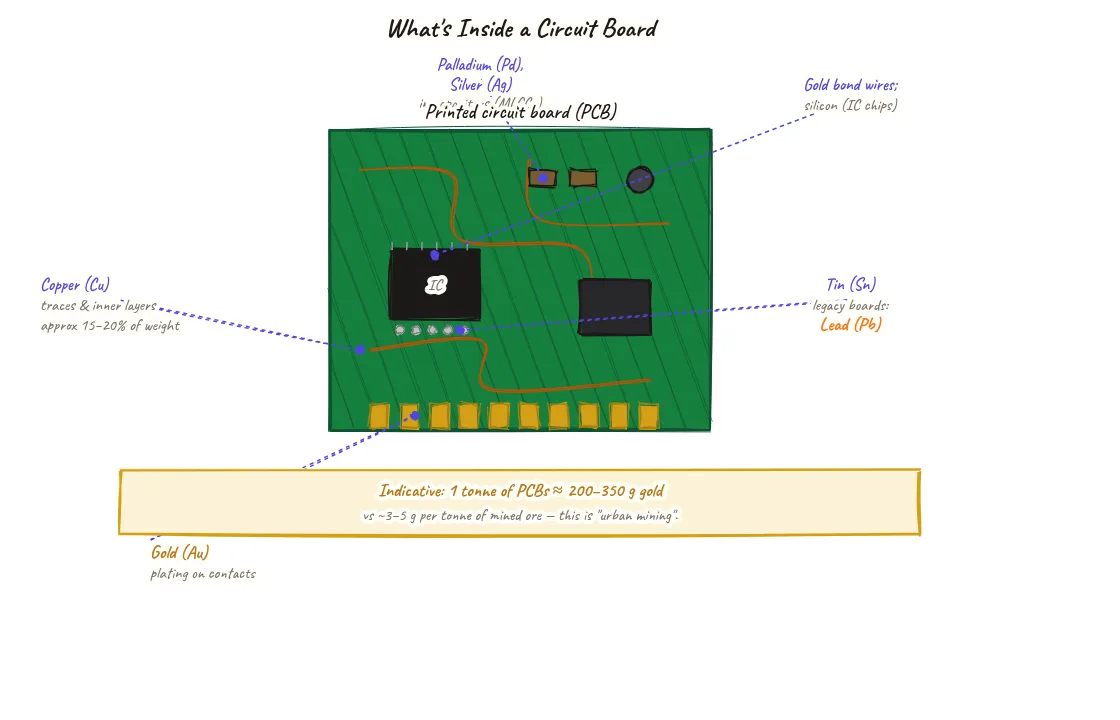
The third stream is the residual fraction: plastics, glass and printed circuit boards that are neither magnetic nor strongly conductive. In an Indian dismantling operation this residual stream is rarely waste. The board fraction is the valuable part, holding the gold, palladium and copper that go on to refining, while the mixed plastics are baled and sold on.
The strength of this two-step approach is that it needs no chemicals, no heat and very little skilled labour, so it forms the backbone of almost every mechanical e-waste line. Its limit is selectivity: it sorts by magnetism and conductivity, not by exact metal type, so the streams it produces still need either hand-picking or a refining route to turn into saleable, single-metal products.
Key insights
- The overband magnet pulls out ferrous metals first because it is the simplest and cheapest separation in the line.
- An eddy-current separator works by inducing a current in conductive pieces so aluminium and copper are physically thrown off the belt.
- Material that is neither magnetic nor conductive drops through as the residual stream of plastics, glass and circuit boards.
- The whole process is dry and chemical-free, which is why it is the standard front end of mechanical e-waste recycling.
- These machines sort by physical property, not exact metal, so the output streams still need hand-picking or refining to become clean products.