Hydrometallurgy vs Pyrometallurgy
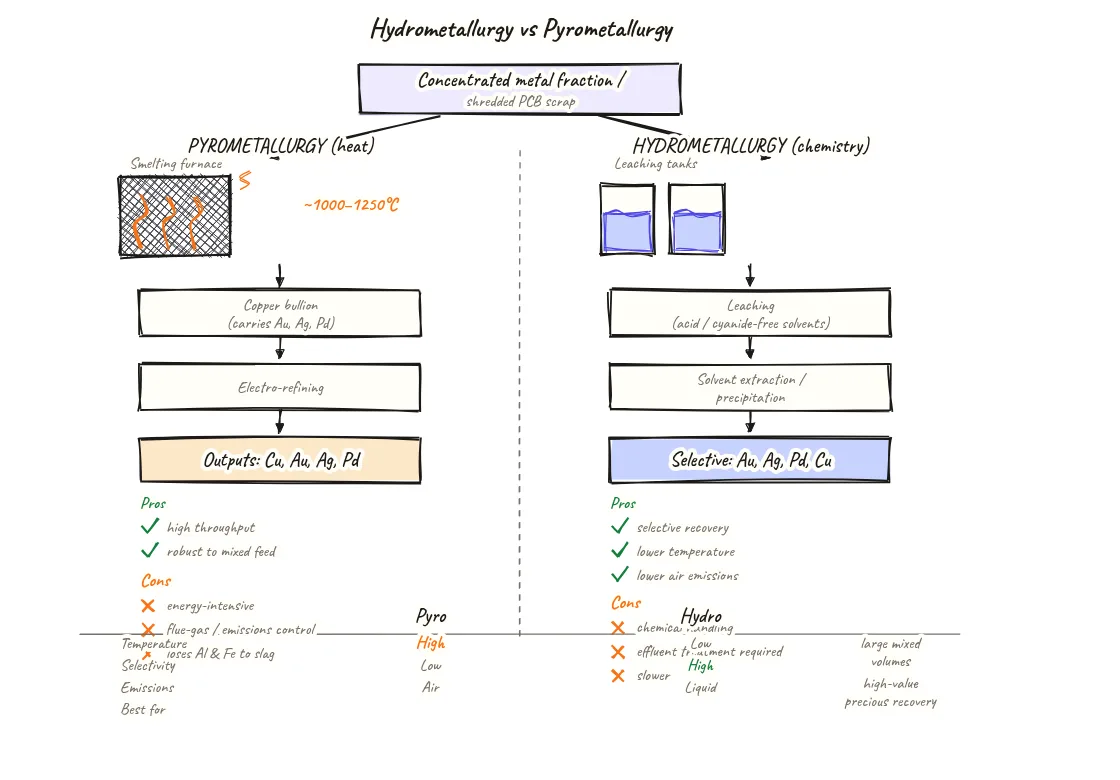
Two ways to recover metals from circuit-board scrap side by side: pyrometallurgy uses heat and smelting, hydrometallurgy uses chemistry, leaching and solvent extraction.
Beyond definitions
Planning to start a E-waste business?
Get the full business understanding — capex, regulations, machinery, vendor questions, and risk checks before you commit capital.
How to read this sketch
- Top box: the shared starting material, concentrated metal fraction or shredded PCB scrap, feeds both columns.
- Left column (pyrometallurgy): the heat path, reading downward through smelting, copper bullion and electro-refining.
- Right column (hydrometallurgy): the chemistry path, reading downward through leaching and solvent extraction or precipitation.
- Bottom outputs: both routes converge on recovered Cu, Au, Ag and Pd; the difference is how they get there.
About this sketch
This comparison sets the two main metal-recovery routes for e-waste side by side, starting from the same input: a concentrated metal fraction or shredded printed-circuit-board scrap. The choice between them shapes the capital cost, the emissions profile and the licensing burden of an integrated refining business.
Pyrometallurgy is the heat route. The scrap is fed into a smelter operating at roughly 1000 to 1250 degrees Celsius, where the organics burn off and the metals melt and collect as copper bullion. That bullion is then purified through electro-refining, and the precious metals report to the anode slimes for later recovery. Pyrometallurgy handles mixed, dirty feed well and is fast, but it demands serious emissions control because burning boards releases dioxins and brominated compounds, which is why it sits almost entirely with large licensed smelters.
Hydrometallurgy is the chemistry route. The metals are dissolved into solution by leaching with acids, then separated and concentrated through solvent extraction and precipitation to recover copper, gold, silver and palladium as distinct products. It runs at near-ambient temperature, is far more selective metal-by-metal, and avoids the air emissions of smelting, but it generates acidic effluent that must be treated and works best on a cleaner, pre-concentrated feed.
For an Indian operator the practical takeaway is a trade-off, not a winner. Smelting suits high tonnage with the air-pollution permits and capital to match, while hydrometallurgy suits a smaller, more controllable plant that can manage liquid effluent and feed it a well-sorted board concentrate. Many integrated refiners ultimately combine both, smelting to a copper-rich intermediate and then using chemistry to split out the precious metals cleanly.
Key insights
- Both routes start from the same concentrated board scrap but recover metals in completely different ways.
- Pyrometallurgy smelts the scrap at around 1000 to 1250 degrees Celsius into copper bullion, then purifies it by electro-refining.
- Hydrometallurgy dissolves the metals by leaching, then separates them through solvent extraction and precipitation at near-room temperature.
- Smelting tolerates dirty mixed feed but needs strong air-emissions control; chemistry is cleaner on air but produces acidic effluent.
- Many integrated refiners combine both: smelt to a copper-rich intermediate, then use chemistry to split out the precious metals.