Hazardous Fractions in E-Waste
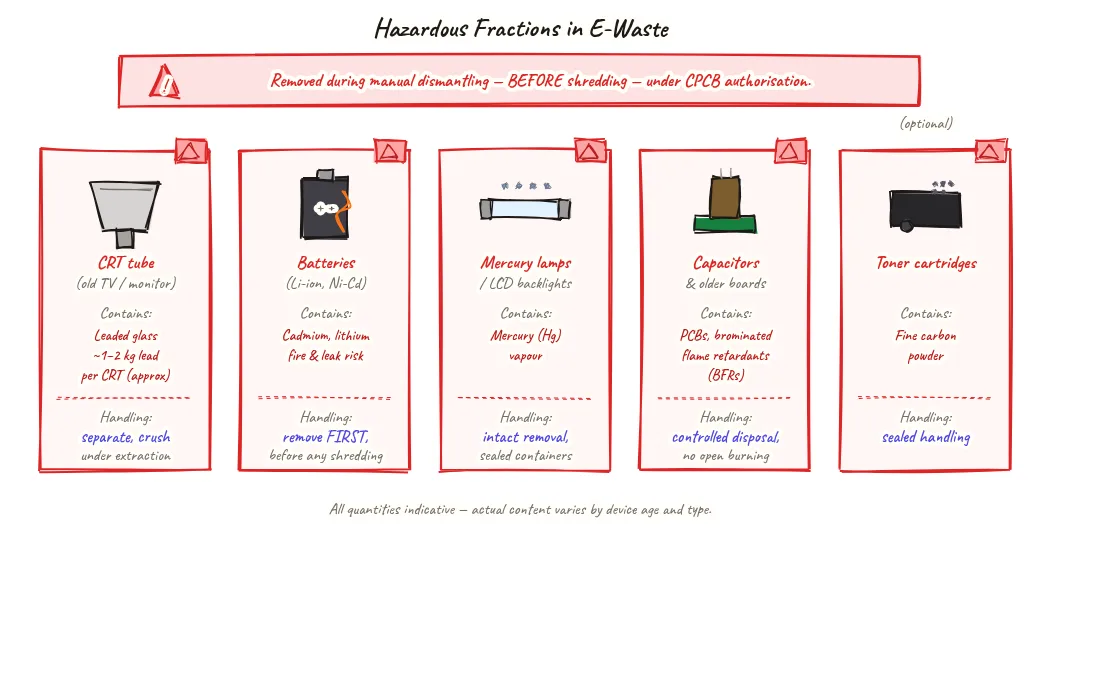
The dangerous parts of e-waste, CRT leaded glass, lithium and cadmium batteries, mercury lamps and PCB-bearing capacitors, each shown with what it contains and how it must come out before shredding.
Beyond definitions
Planning to start a E-waste business?
Get the full business understanding — capex, regulations, machinery, vendor questions, and risk checks before you commit capital.
How to read this sketch
- Each row: pairs a hazardous item (left) with what it contains and how it must be removed (right).
- CRT tube: leaded glass, removed intact and sent to specialist glass handlers.
- Batteries: cadmium and lithium, removed before shredding to avoid fire and contamination.
- Mercury lamps and backlights: mercury vapour, handled in controlled breakage units.
- Capacitors and toner: PCBs, BFRs and carbon dust, routed to authorised disposal.
About this sketch
This diagram lays out the hazardous fractions that have to be taken out of e-waste by hand before anything goes into a shredder. Getting this sequence right is the single most important safety and compliance step in a dismantling operation, because once these items are shredded their toxins spread through the whole material stream and can no longer be isolated.
The CRT tube from old monitors and televisions contains leaded glass, with several kilograms of lead per tube in the funnel glass. Batteries, both lithium-ion and nickel-cadmium, carry cadmium and lithium; lithium cells in particular are a fire risk if punctured in a shredder. Mercury lamps and LCD backlights release mercury vapour if broken, a serious inhalation hazard. Capacitors and older boards can hold PCBs (polychlorinated biphenyls) and brominated flame retardants (BFRs), and toner cartridges contain fine carbon powder that becomes an airborne dust hazard.
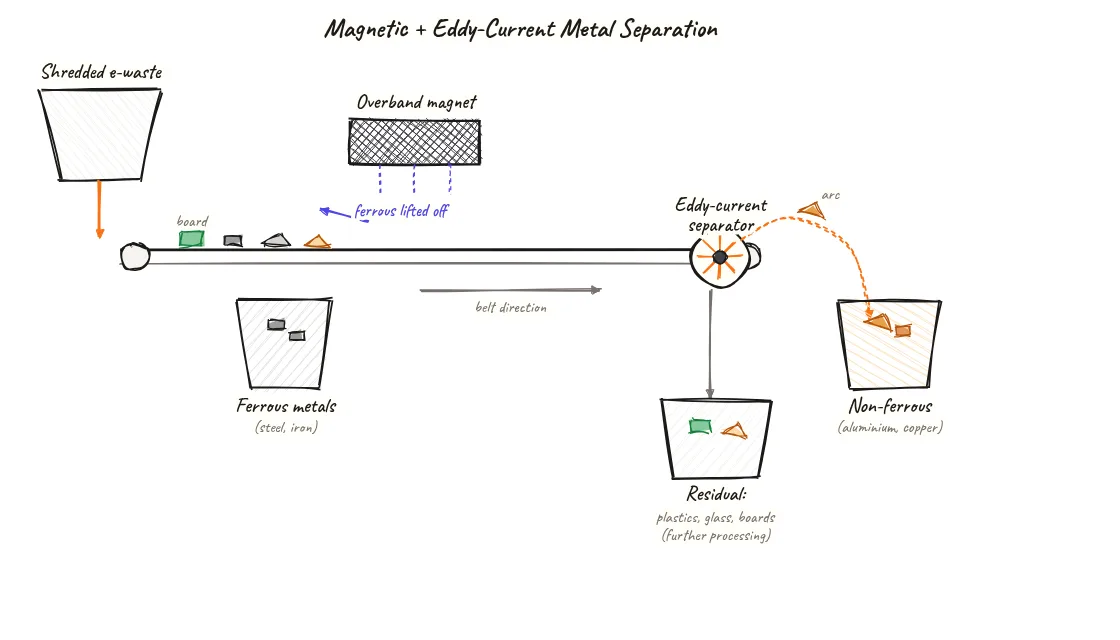
For each item the diagram pairs what it contains with how it must be removed: intact, manually, and routed to a dedicated downstream channel rather than the general fraction. Lithium and CRT items go to specialist handlers, mercury devices to controlled breakage units, and PCB-bearing capacitors to authorised disposal. None of these should ever reach the magnetic or eddy-current line.
Under India's E-Waste (Management) Rules and the Hazardous Waste rules, this depollution step is mandatory and auditable, not optional. A dismantler that skips it not only endangers workers but loses its authorisation, so the manual removal bench shown here is a regulatory requirement as much as a safety one.
Key insights
- Hazardous items must be removed by hand before shredding, because shredding spreads their toxins through the whole stream.
- CRT tubes carry leaded glass, with several kilograms of lead in the funnel glass of older monitors and TVs.
- Lithium and nickel-cadmium batteries are both a contamination and a fire risk if punctured in a shredder.
- Mercury lamps and LCD backlights release mercury vapour when broken and need controlled breakage handling.
- Under India's E-Waste and Hazardous Waste rules this depollution step is mandatory and auditable, not optional.