Manual vs Automated Sorting Line
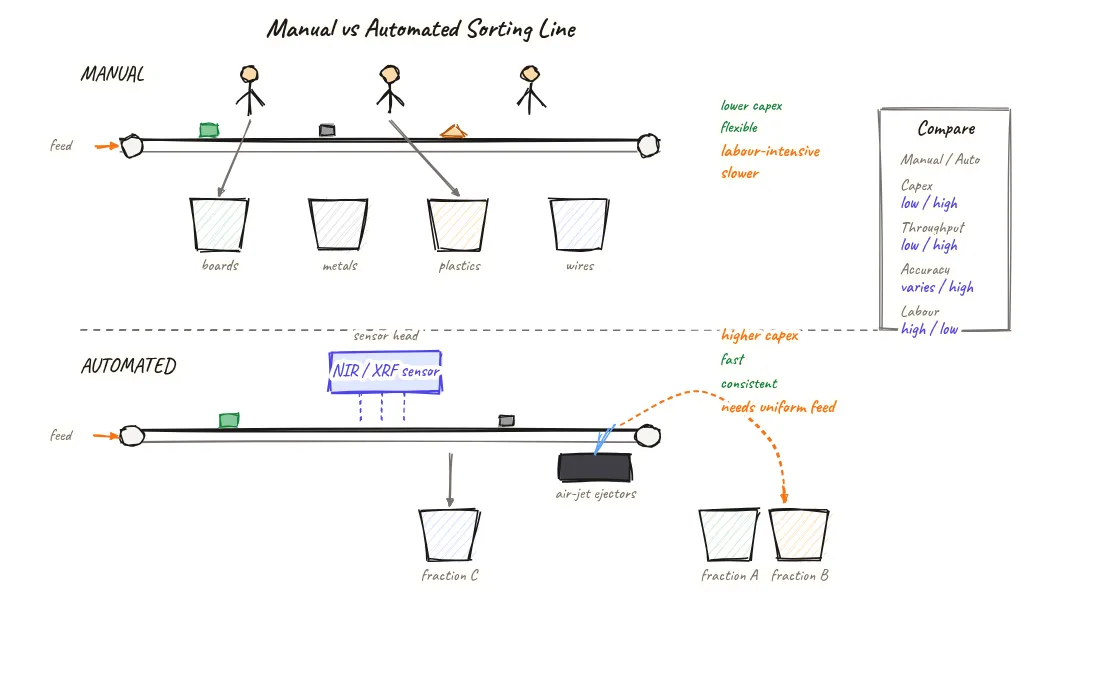
A hand-picking belt set against a sensor-based sorting line that uses NIR and XRF sensors with air-jet ejectors, compared on capex, throughput, accuracy and labour.
Beyond definitions
Planning to start a E-waste business?
Get the full business understanding — capex, regulations, machinery, vendor questions, and risk checks before you commit capital.
How to read this sketch
- Left side (manual): the picking belt with workers sorting into boards, metals, plastics and wires bins.
- Right side (automated): the sensor line, reading the NIR/XRF sensor head then the air-jet ejectors that fire fragments off the belt.
- Air-jet arrows: show selected pieces being puffed sideways into the correct bin.
- Compare strip (bottom): the four decision axes, capex, throughput, accuracy and labour, for the two approaches.
About this sketch
This diagram puts the two ways of sorting e-waste fragments side by side, the manual picking belt and the automated sensor line, and shows where each one wins. Sorting sits right after shredding and decides how clean the output streams are, so the choice between people and sensors shapes both the product quality and the cost structure of the plant.
On the manual picking belt, trained workers stand along a slow conveyor and hand-pick fragments into bins for boards, metals, plastics and wires. This route has low capital cost and adapts instantly to odd or mixed material a sensor would struggle with, but throughput is capped by how fast hands can move and accuracy drifts with fatigue. It remains the common starting point for Indian dismantlers because it is cheap to set up and creates local jobs.
The automated line replaces eyes with sensors. A NIR (near-infrared) sensor head identifies different plastics by the way they reflect infrared light, while an XRF (X-ray fluorescence) head reads the metal composition of each piece. The sensors trigger fast air-jet ejectors that puff selected fragments off the belt into the right bin at high speed. This gives much higher throughput and consistent accuracy that does not tire, at the cost of significant upfront capital and the need for technicians to keep it calibrated.
The compare strip at the bottom frames the real decision on four axes: capex, throughput, accuracy and labour. Manual wins on capex and flexibility; automated wins on throughput and consistent accuracy while cutting headcount. In practice many Indian plants run a hybrid, automating the high-volume plastic and metal split while keeping a manual bench for the high-value board picking where human judgement still pays.
Key insights
- Manual picking has low capital cost and adapts to odd material, but throughput is limited and accuracy drifts with fatigue.
- An automated line uses NIR sensors to identify plastics and XRF sensors to read metals, then air-jet ejectors to sort them.
- Automation delivers higher, steadier throughput and consistent accuracy but needs heavy upfront capital and technician upkeep.
- The real trade-off sits on four axes: capex, throughput, accuracy and labour.
- Many Indian plants run a hybrid: automate the high-volume plastic and metal split, keep a manual bench for high-value boards.