Rotary Drum Dryer
A rotary drum dryer removes moisture from pre-shredded plastic before it enters the reactor, rotating at 0.5–3 RPM with hot air at 80–180°C to bring moisture below 1% — preventing pressure surges during pyrolysis.
Beyond definitions
Planning to start a Plastic Pyrolysis business?
Get the full business understanding — capex, regulations, machinery, vendor questions, and risk checks before you commit capital.
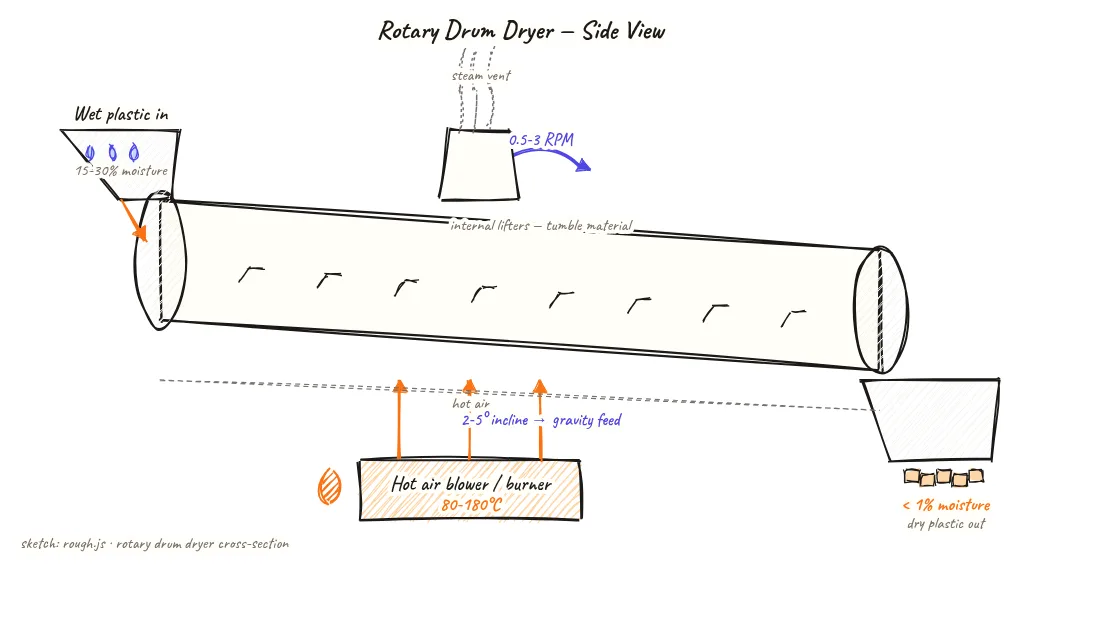
How to read this sketch
This is a side (elevation) view of the dryer, drawn in cross-section to show internal details. Read it as follows:
- Left (elevated) end: Feed end — wet plastic enters here. Hot air burner also located here, firing hot air into the drum in the same direction as material flow (co-current drying).
- Drum wall: The partially transparent drum shows internal lifters as angled fins projecting inward.
- Steam vent: Located toward the feed end — moist exhaust air exits here.
- Right (lower) end: Discharge end — dry plastic exits here by gravity after travelling the full drum length.
- Labels: 0.5–3 RPM (rotation speed), 80–180°C (air temperature inside drum), <1% moisture (output target).
About this sketch
Moisture in pyrolysis feedstock is a serious operational problem. Water introduced into a reactor running at 350–550°C instantly flashes to steam, causing rapid pressure spikes that trip pressure-relief valves, interrupt the batch cycle, and — at higher moisture levels — risk overpressure incidents. The rotary drum dryer solves this by reducing feedstock moisture to below 1% before it reaches the reactor.
The dryer is a long, inclined cylinder rotating slowly at 0.5–3 RPM on trunnion rollers. Inside, lifting flights (lifters) pick up plastic granules and shower them through a hot air stream at 80–180°C — the temperature range is set below the softening point of most thermoplastics (which start softening above 120°C for thin PE film and 150°C for PP and HDPE) to avoid particle agglomeration inside the drum. The slight downhill inclination moves material from the feed end to the discharge end by gravity as the drum rotates.
Water evaporates as steam and exits through a steam vent near the feed end where the air is hottest and most saturated. The discharged plastic exits at the lower end with moisture typically below 1%, measured by a moisture sensor before the reactor feed auger. For a 10 TPD plant, a dryer drum of 1.5 m diameter and 8–12 m length is typical, with a heat input of 50–100 kW from the hot air burner (often fired on syngas during steady operation).
The dryer is often the bottleneck for plants in humid climates (monsoon season in coastal India) where incoming feedstock moisture can reach 15–25% from open storage. Installing a covered feedstock yard to keep plastic dry before the dryer significantly reduces drying energy and improves reactor throughput.
Key insights
- Plastic feedstock must be below 1% moisture before entering the reactor — higher moisture causes steam pressure spikes that interrupt the batch and risk overpressure.
- Drum rotation at 0.5–3 RPM is slow to avoid material compaction and agglomeration; the lifting flights shower plastic through the hot air stream for maximum contact.
- Temperature is kept below the plastic softening point (80–120°C for most thermoplastics in film form) to prevent particles from sticking together inside the drum.
- A covered feedstock storage yard significantly reduces drying energy and increases reactor throughput, especially in humid coastal or monsoon conditions.
- Syngas from the reactor can fire the hot air burner once the plant reaches steady state, making the dryer energy nearly free after startup.