Emission Control System
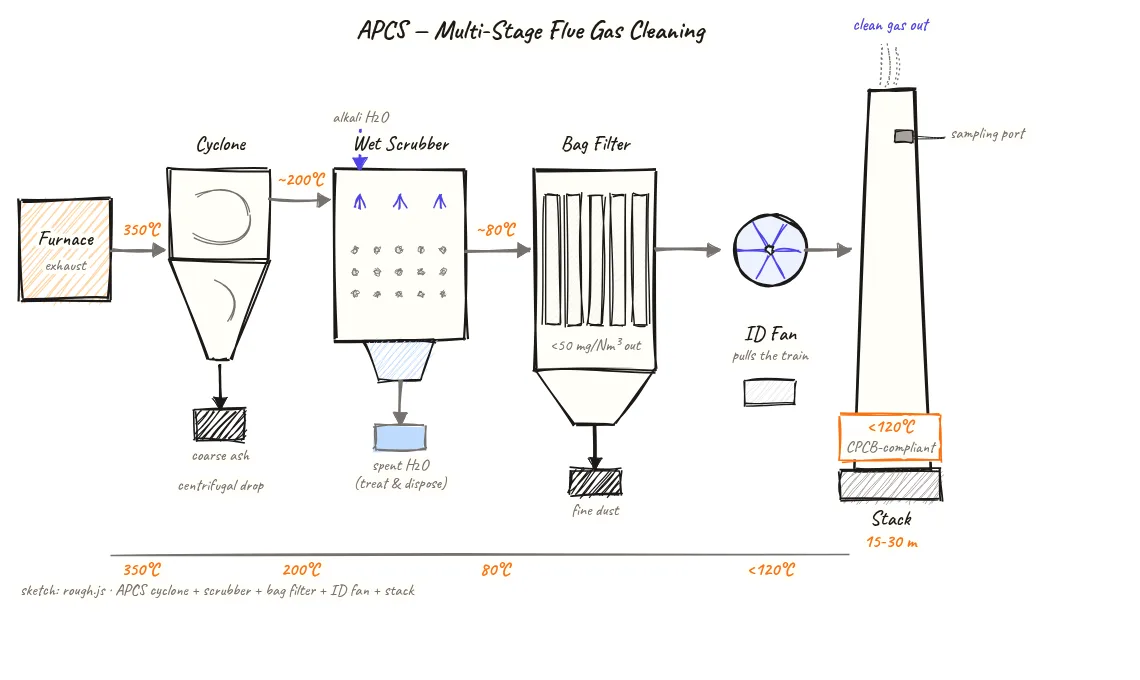
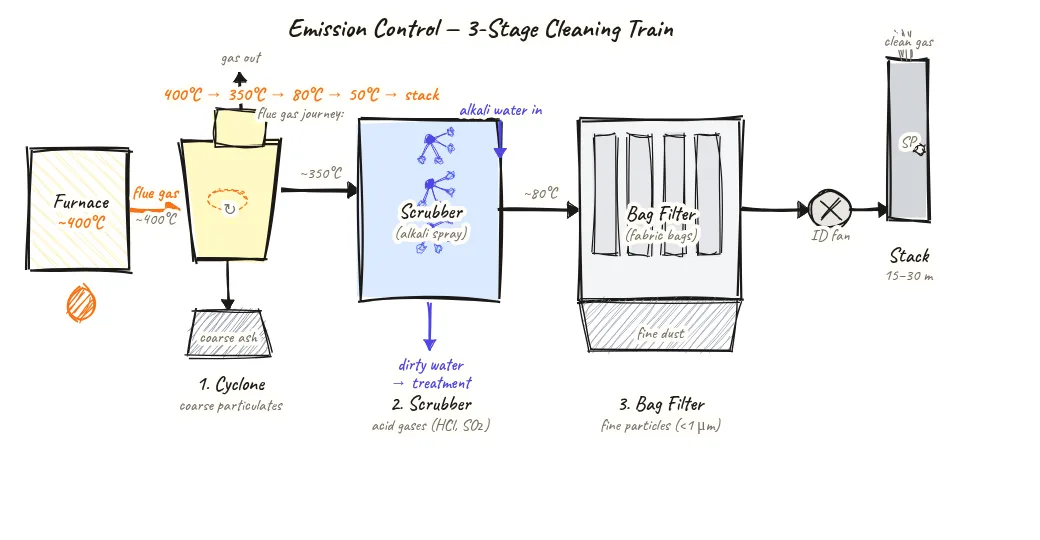
A three-stage emission control system — cyclone, wet scrubber, and bag filter — treats furnace flue gas in series, with each stage targeting a different pollutant size and type before the cleaned gas exits through the chimney stack.
Beyond definitions
Planning to start a Plastic Pyrolysis business?
Get the full business understanding — capex, regulations, machinery, vendor questions, and risk checks before you commit capital.
How to read this sketch
This is a left-to-right process flow. Flue gas flows from left to right, becoming cleaner at each stage. Read as follows:
- Each stage box: One treatment unit with its symbol and removal target labelled.
- Downward arrows (at cyclone and scrubber): Collected pollutant streams (ash from cyclone, effluent from scrubber) exit downward for disposal or treatment.
- Temperature labels: 350°C at flue gas inlet, dropping to ~70°C after scrubber (saturation temperature). Below 120°C required before bag filter.
- Caption: 'Three stages, three different pollutants — each box handles what the previous one couldn't.'
About this sketch
Furnace flue gas from a plastic pyrolysis plant contains three categories of pollutants: coarse fly ash and char particles, water-soluble acid gases (HCl from PVC contamination, SO₂ from sulphur in plastic additives), and fine particulate matter (PM10, PM2.5). No single piece of equipment removes all three effectively — which is why the emission control system uses three different technologies in series, each doing what the others cannot.
Stage 1 — Cyclone separator: Hot flue gas (350°C or above) enters the cyclone tangentially, spinning at high velocity. Centrifugal force pushes heavier particles (above 10–20 microns — coarse fly ash, char fines) to the cyclone wall and down into the collection hopper. Clean gas exits the cyclone top. The cyclone is a purely mechanical device with no consumables — the only maintenance is periodic ash hopper emptying. It handles 70–90% of the total particulate mass load but cannot remove fine PM2.5 particles.
Stage 2 — Wet scrubber: Gas from the cyclone enters the scrubber where it contacts a water or alkaline solution spray. Fine particles (2–10 micron range) are captured by the water droplets. More importantly, water-soluble acid gases (HCl, SO₂) dissolve into the scrubber liquid, which is collected at the bottom as a slightly acidic or alkaline effluent. This effluent must be neutralised and treated before discharge or recycling. The scrubber reduces gas temperature to near its saturation point (50–70°C), which also helps the downstream bag filter work within its temperature limit.
Stage 3 — Bag filter (fabric filter): Fine particles (0.5–5 microns — the PM2.5 and PM10 range that both the cyclone and scrubber miss) are captured on the fabric bags as gas passes through them. Bags are periodically cleaned by pulse-jet or mechanical shaking. Bag filter performance is typically PM below 30 mg/Nm³ at the outlet, meeting CPCB norms. The ID fan after the bag filter maintains negative pressure throughout the train.
Key insights
- The cyclone, scrubber, and bag filter each target a different pollutant type — no single stage can do all three jobs, which is why all three are needed in series.
- The wet scrubber is specifically needed when PVC-contaminated feedstock is processed — it is the only stage that removes HCl gas from the flue stream.
- Gas must be cooled below 120°C (by the scrubber stage) before entering the bag filter — temperatures above this damage the glass fibre or PTFE bag filter fabric.
- CPCB norms require particulate matter at the stack to be below 50 mg/Nm³ — the three-stage system typically achieves 20–30 mg/Nm³, providing a compliance margin.
- Scrubber effluent (acidic water with absorbed HCl and SO₂) cannot be discharged to drains without neutralisation — this effluent must be pH-adjusted and treated before disposal.