Oil Storage Yard — Fire Safety Overlays
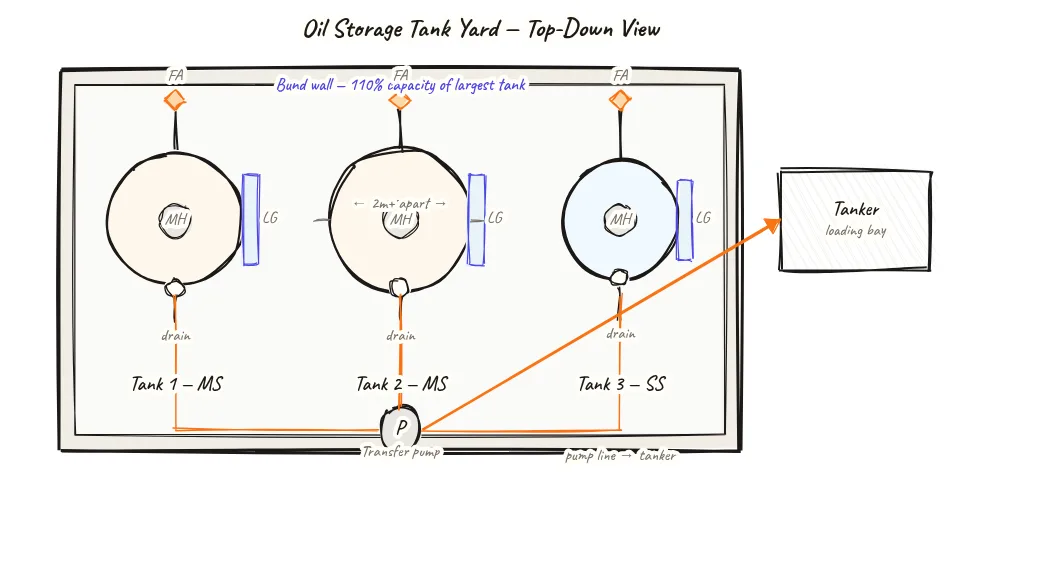
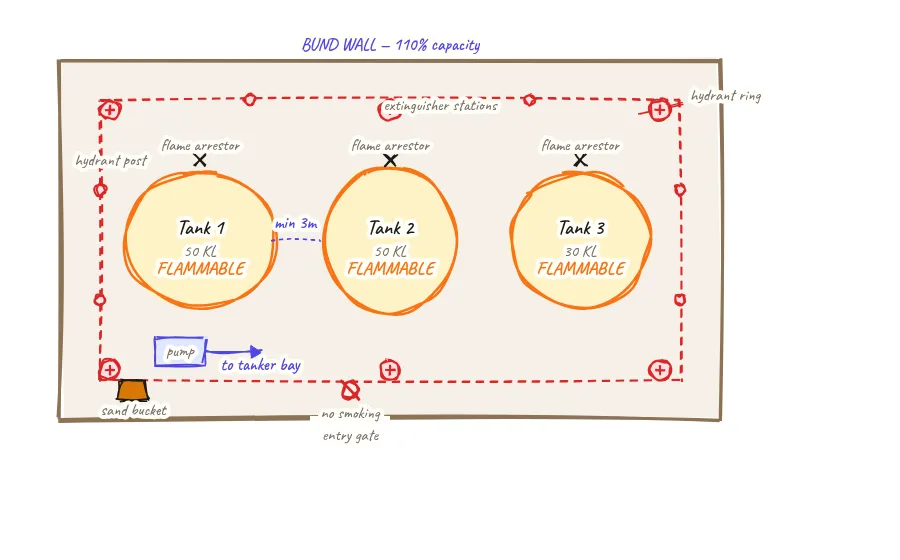
The fire safety overlay on an oil storage yard shows how every risk is addressed — flame arrestors on vents, hydrant ring inside the bund, fire extinguisher stations at each corner, no-smoking zone, and sand buckets — confirming that every tank is protected and every corner has a response resource.
Beyond definitions
Planning to start a Plastic Pyrolysis business?
Get the full business understanding — capex, regulations, machinery, vendor questions, and risk checks before you commit capital.
How to read this sketch
This is a top-down plan view of the storage yard with fire safety overlays. Read each element systematically:
- Bund wall (outer rectangle): Primary spill containment. All tanks inside.
- Hydrant ring (pipe loop inside bund): Pressurised water supply running around the inside of the bund perimeter.
- Corner stations (circle symbols at corners): Fire extinguisher + sand bucket locations. One at each of the four bund corners.
- Flame arrestors (mesh symbols on tank vents): One per vent on each tank.
- No-smoking sign (at bund entrance): Marks the boundary of the restricted zone.
- Tanker bay (outside bund, at bottom): Connected to bund by a pipe passing through the bund wall with an isolation valve. Earthing cable shown at the loading connection.
- Caption: 'Every tank is inside the bund. Every vent has a flame arrestor. Every corner has an extinguisher.'
About this sketch
An oil storage yard is classified as a high-fire-risk zone under PESO and CPCB regulations, and the fire safety infrastructure required is specific and non-negotiable. This diagram overlays all the required fire safety elements onto a standard three-tank storage yard — making it clear that fire safety design is not an afterthought but part of the yard layout from the start.
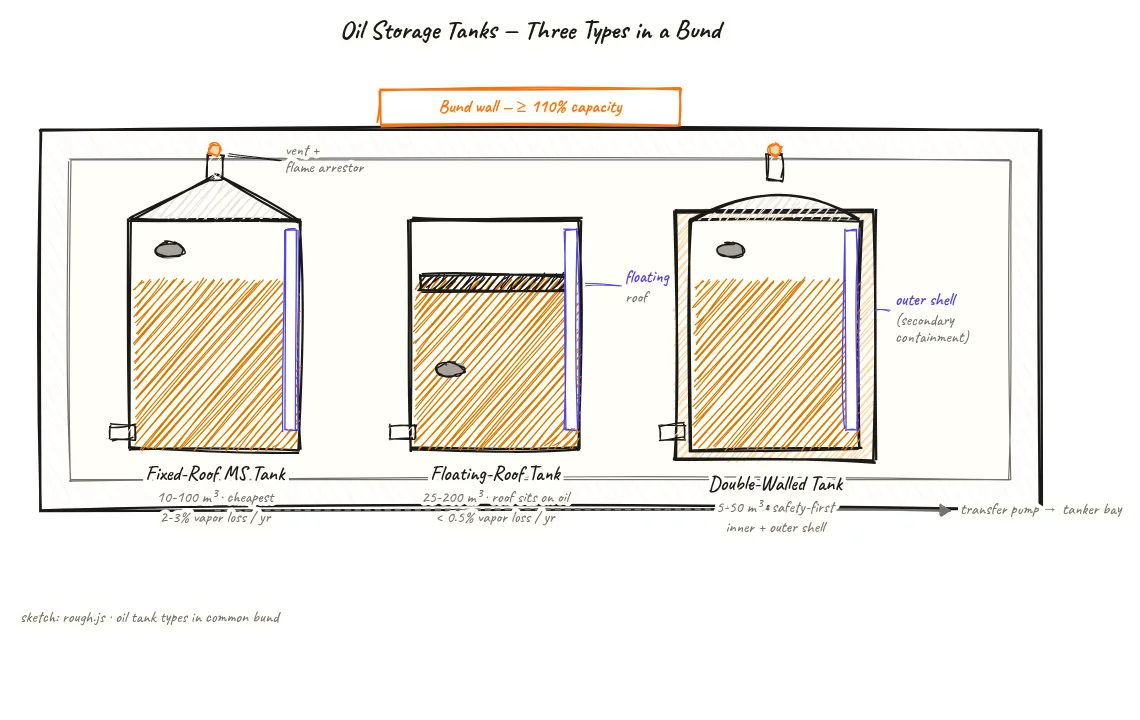
The central containment is the bund wall — already discussed in the tank type diagram. Inside the bund, a hydrant ring (a pipe loop with outlet points at regular intervals) provides pressurised water for firefighting without requiring a tanker truck to reach the bund. The hydrant ring is connected to the site's water tank (minimum 30–60 minutes of firefighting flow at the design flow rate). Each hydrant outlet has a hose cabinet.
Fire extinguisher stations at all four corners of the bund provide the first-response resource. Dry powder or CO₂ extinguishers rated for Class B fires (flammable liquid) are standard — water extinguishers must NOT be used on oil fires. Sand buckets are co-located at the extinguisher stations as an alternative smothering agent for small spill fires. A clearly marked no-smoking zone begins at the yard entrance and extends to a safe perimeter around the bund.
Every tank vent has a flame arrestor — these prevent any external ignition source (lightning, static, a nearby fire front) from propagating back into the tank headspace. The tanker loading bay is positioned outside the bund and separated by an isolation valve. The loading connection has a grounding cable (earthing strap) to prevent static discharge during transfer — a common ignition cause during bulk liquid transfers. Together, these elements form the layered fire safety system required by PESO for flammable liquid storage.
Key insights
- A hydrant ring inside the bund provides pressurised firefighting water without needing to bring a tanker inside the bunded area during a fire.
- Fire extinguishers for pyrolysis oil storage must be Class B rated (dry powder or CO₂) — water extinguishers are ineffective and dangerous on burning oil fires.
- Static earthing during tanker loading is mandatory — static discharge during high-flow liquid transfer is a known ignition source for flammable liquid fires.
- Flame arrestors are mandatory on every tank vent — a tank without a flame arrestor on the vent fails PESO inspection and cannot receive a storage licence.
- The no-smoking zone must extend at least 15 metres beyond the bund perimeter — this distance exceeds the potential vapour travel distance from tank vents in still air.