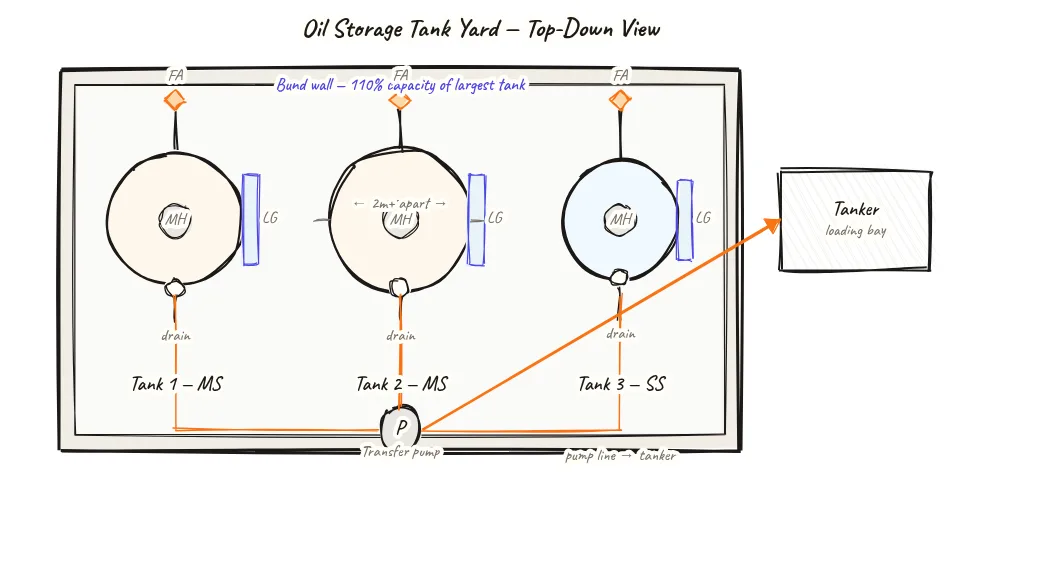
Three Oil Tank Types in a Bund
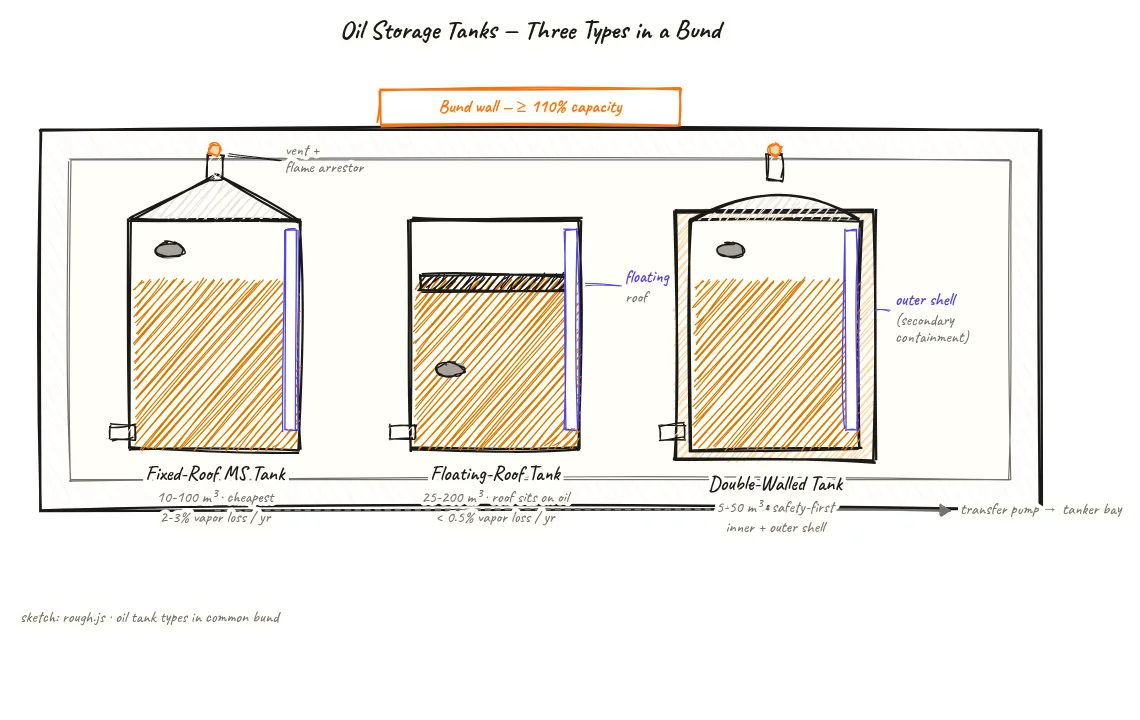
Three designs for storing pyrolysis oil — fixed-roof, floating-roof, and double-walled — shown side by side inside a common bund wall that must contain 110% of the largest tank's capacity as required by CPCB and PESO regulations.
Beyond definitions
Planning to start a Plastic Pyrolysis business?
Get the full business understanding — capex, regulations, machinery, vendor questions, and risk checks before you commit capital.
How to read this sketch
Three tanks shown in elevation (side cross-section view) inside a shared bund wall. Read each as follows:
- Bund wall (outer perimeter): Low concrete or brick wall that contains spills. Label shows 110% containment requirement.
- Fixed-roof tank (left): Roof is permanently welded to the shell. Vent with flame arrestor symbol at the top. Level gauge on the side.
- Floating-roof tank (centre): Curved line inside the tank represents the floating roof deck resting on the liquid surface. Roof position moves with liquid level.
- Double-walled tank (right): Two concentric shells shown with an interstitial gap between them. A detection port accesses the interstitial space.
- Common fittings: Each tank has a manhole (circle on top), drain valve (triangle at bottom), and level gauge (vertical line on side).
About this sketch
Pyrolysis oil is a Class B flammable liquid with a flash point typically in the 40–70°C range, placing it in the same regulatory category as diesel fuel for storage purposes. Choosing the right tank design and constructing the required bund wall correctly is mandatory for statutory approval and critical for fire safety.
The fixed-roof mild steel (MS) tank (left) is the most common and cheapest option. A cone or dome-shaped roof is welded to the shell. Pyrolysis oil vapors collect in the headspace above the liquid, so a vent with flame arrestor is mandatory — this allows the tank to breathe during fill and withdrawal without allowing a flame front to enter. Fixed-roof tanks are standard for plants storing up to a few kilolitres of oil at a time.
The floating-roof tank (centre) has a roof that rests on the liquid surface and rises or falls with the liquid level. This eliminates the vapour headspace in the tank, significantly reducing evaporative emissions and vapour fire risk. It is the preferred choice for larger storage volumes (above 50 KL) or where volatility of the oil is high. The floating roof seal is the main maintenance point.
The double-walled tank (right) has a primary inner shell and a secondary outer shell with an interstitial space between them. Any leak from the primary shell is contained in the interstitial space and detected by a level sensor before it reaches the bund. This design is often required for tanks near sensitive areas (groundwater recharge zones, water bodies) where a single-wall tank leak would be a serious environmental incident.
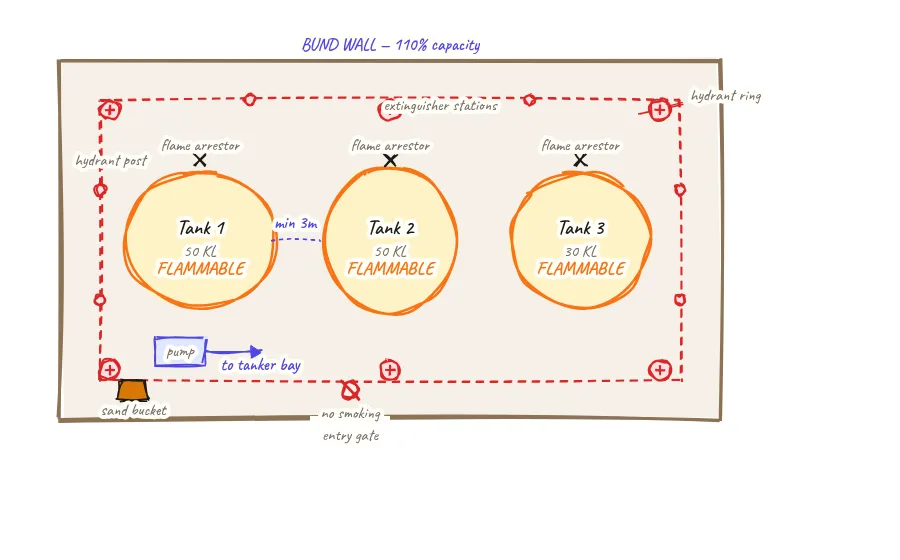
All three tanks sit inside a common bund wall. CPCB and PESO regulations require the bund to contain at least 110% of the largest single tank's volume. In practice, a bund that contains all tanks is more practical and is standard for most small pyrolysis plants with 2–5 tanks. Every tank also has a manhole, drain valve, and level gauge as standard fittings.
Key insights
- The bund wall must contain at least 110% of the largest tank's volume — a statutory requirement under CPCB and PESO regulations for flammable liquid storage.
- Every fixed-roof pyrolysis oil tank must have a vent fitted with a flame arrestor — without it, vapors in the headspace could ignite from a static discharge or nearby heat source.
- Floating-roof tanks eliminate the vapour headspace and are the preferred design for larger storage volumes above 50 KL, reducing both fire risk and evaporative losses.
- Double-walled tanks detect leaks in the interstitial space before liquid reaches the ground — required near sensitive environmental zones.
- Pyrolysis oil with flash point below 65°C is classified as Class B flammable liquid, triggering PESO licensing requirements for tanks above specified volumes.