Reactor Energy Balance — From Diesel to Self-Sustaining
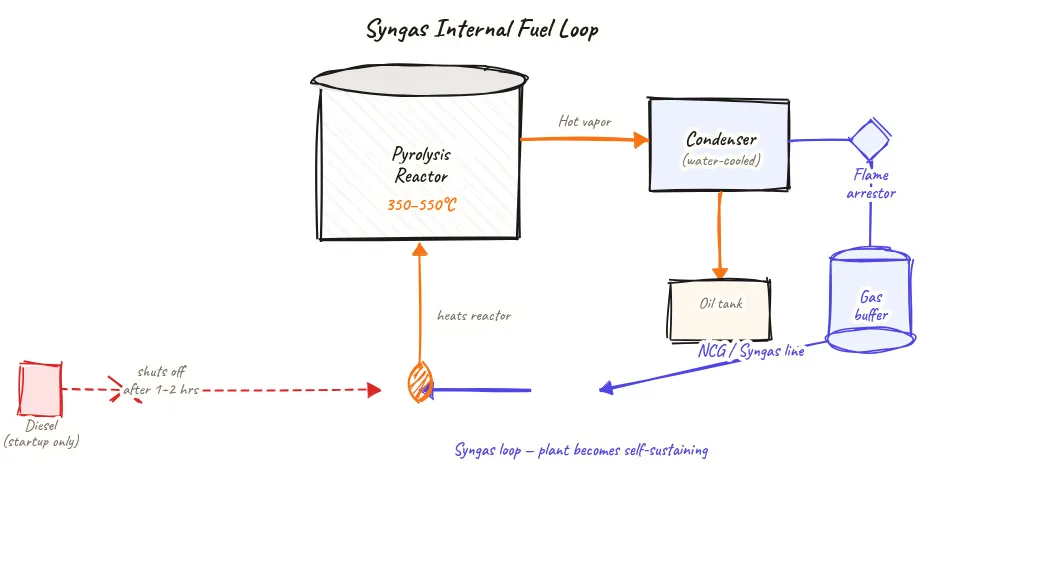
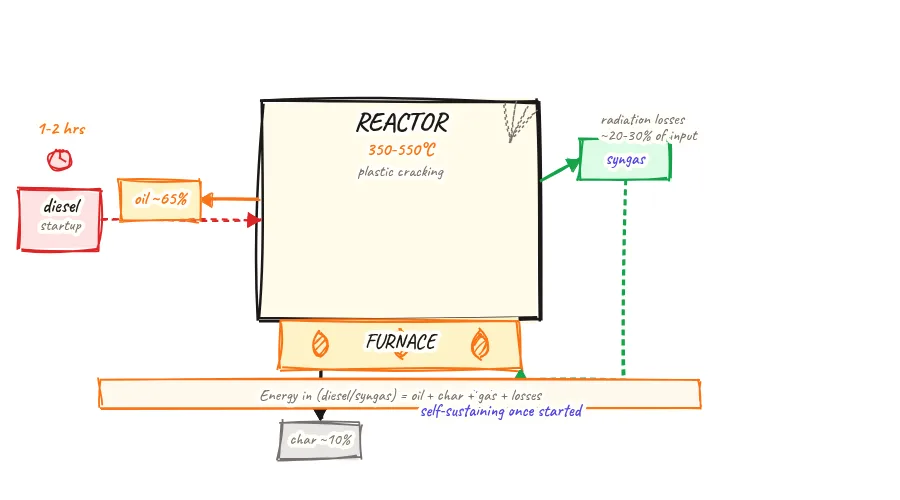
The reactor energy balance shows two phases — the first 1–2 hours run on diesel, then syngas from the condenser takes over as furnace fuel — making overall energy input approximately 15–20% of feedstock energy content, with 70–80% leaving as sellable products.
Beyond definitions
Planning to start a Plastic Pyrolysis business?
Get the full business understanding — capex, regulations, machinery, vendor questions, and risk checks before you commit capital.
How to read this sketch
This is an energy balance diagram where arrows represent energy flows, not material flows. Read it as follows:
- Reactor + furnace (centre): The core thermal system. Furnace wraps around the reactor and heats it.
- Red dashed arrow (left, early phase): Diesel startup energy with clock icon labelling the 1–2 hour startup window.
- Green dashed loop arrow (steady state): Syngas from condenser looping back to furnace burner — replaces diesel after startup.
- Energy output arrows (right): Three output energy flows — oil vapors (largest), char (medium), heat losses (smallest).
- Caption: 'Diesel for 1–2 hours, then the plant runs on its own gas.'
About this sketch
Every pyrolysis operator hears that the plant becomes self-sustaining after startup — but what does the energy balance actually look like? This diagram shows reactor energy flows at two operating phases.
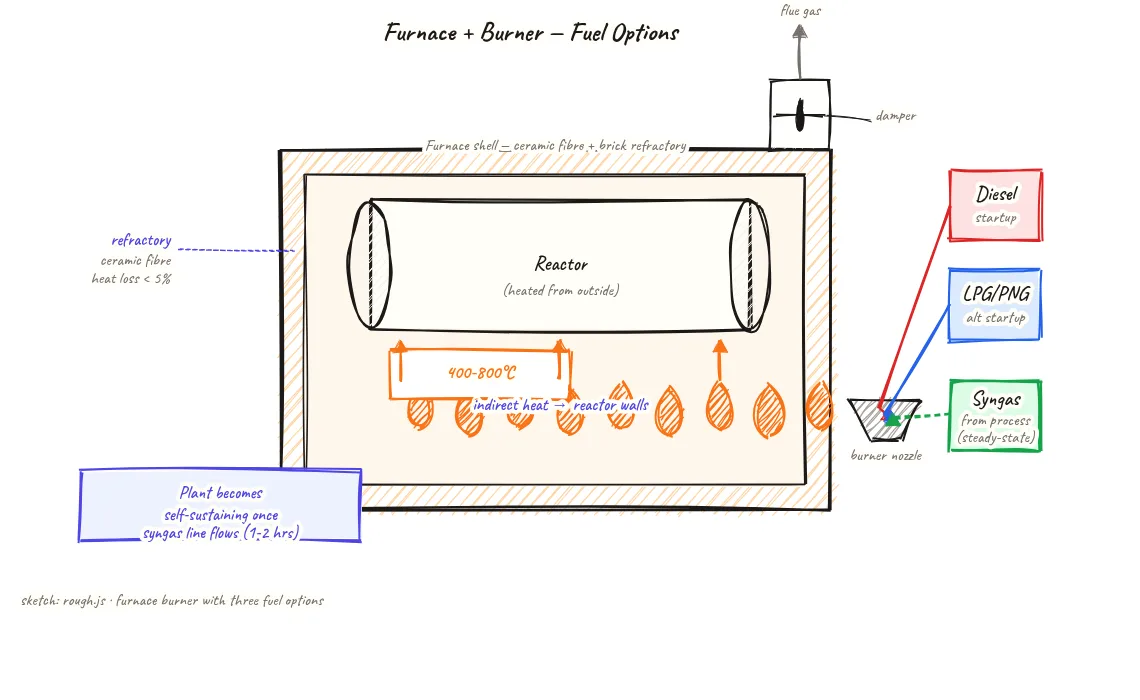
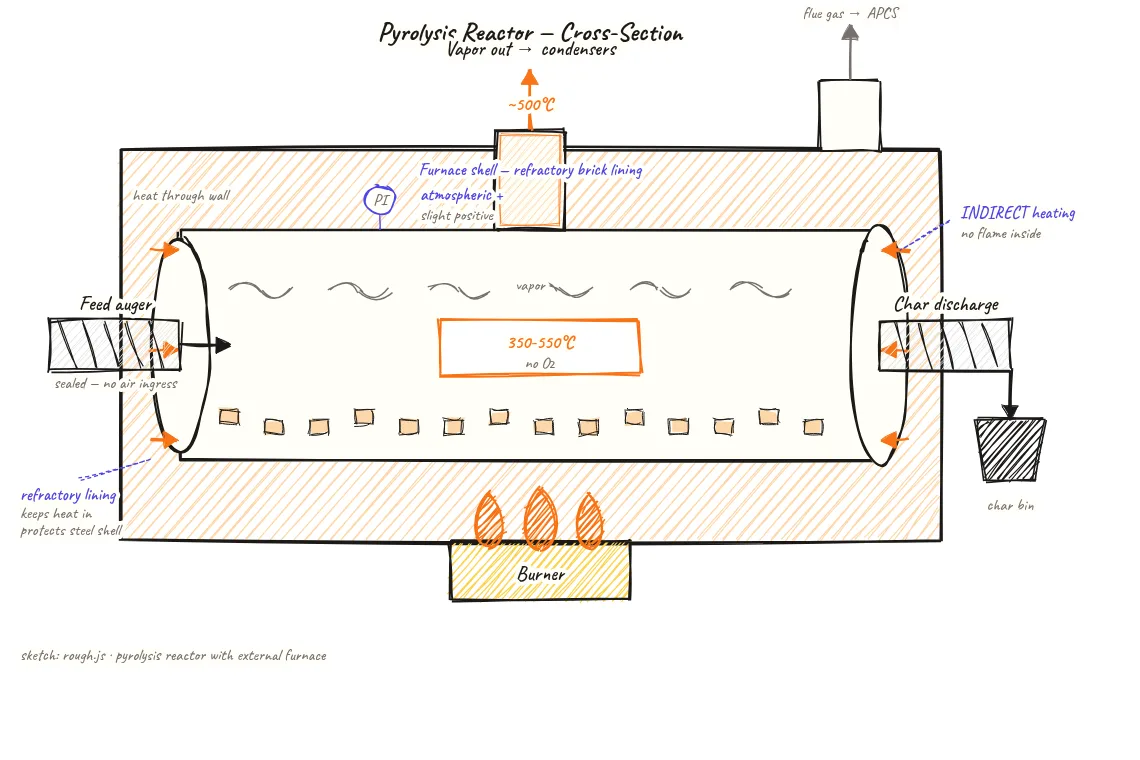
Startup phase (first 1–2 hours): The reactor is cold. The furnace burns diesel or LPG to raise the reactor from ambient to operating temperature (350–550°C). For a typical 2–3 tonne batch reactor, startup fuel consumption is 15–40 litres of diesel.
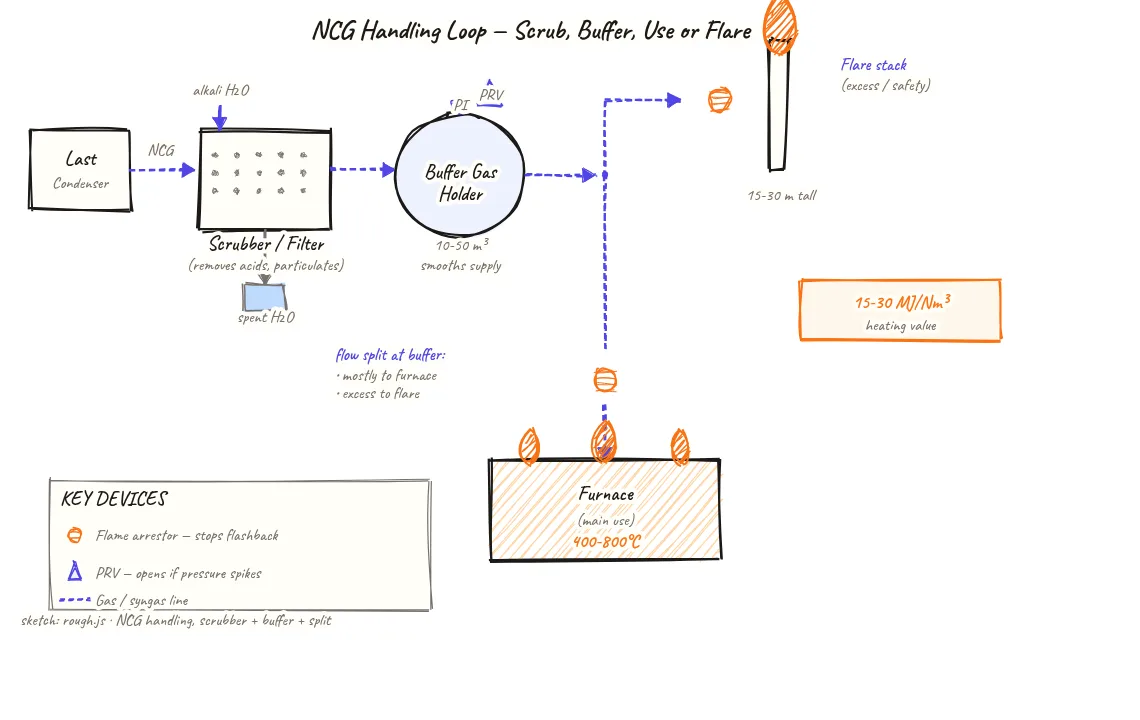
Steady-state phase (after 1–2 hours): As the reactor reaches operating temperature, plastic begins cracking and vapors flow to the condenser. Non-condensable gas (NCG, syngas) builds up in the gas holder. The furnace switches from diesel to syngas — the green dashed loop arrow in the diagram. From this point, energy input equals syngas energy from the NCG loop; energy output equals pyrolysis oil vapors (primary product) plus char (secondary) plus heat losses through the reactor wall insulation.
The steady-state energy balance is approximately: 15–20% of the plastic's original energy content is consumed internally as syngas furnace fuel; 55–65% exits as pyrolysis oil; 8–12% exits as char; 5–10% is heat loss. Net energy efficiency — useful product energy out versus plastic energy in — is approximately 70–80%, significantly higher than incineration which captures only 20–30% as electricity through a steam cycle. This is the core commercial and environmental argument for pyrolysis: the plant extracts most of the energy locked in waste plastic as a sellable liquid fuel rather than burning it and losing most to flue gas.
Key insights
- The pyrolysis plant is energy self-sustaining after 1–2 hours of diesel startup — the syngas from the NCG loop provides all the furnace energy for the rest of the batch.
- Approximately 15–20% of the plastic's original energy content is consumed internally as syngas furnace fuel — the rest exits as oil (55–65%) and char (8–12%).
- Overall energy efficiency of 70–80% (useful products out versus plastic energy in) is significantly higher than incineration, which recovers only 20–30%.
- Diesel startup cost is a minor variable cost — typically 15–40 litres per batch for a 2–3 tonne reactor, representing 1–3% of the total batch revenue.
- Heat losses through the reactor wall (5–10%) are reduced by well-maintained refractory — cracked or thin refractory increases heat loss and diesel consumption.